Film Faced Plywood for Concrete Formwork: Why Contractors Use It
Introduction
Film faced plywood for concrete formwork must do more than provide a flat surface. It has to carry fresh-concrete pressure, stay stable during casting, release cleanly after curing, and tolerate the moisture and mechanical wear of a construction site. That is why professional buyers look beyond surface color or a low unit price. The real performance comes from the combination of plywood core, bonding quality, face film, edge sealing, panel thickness, formwork design, and site handling.
The Role of the Film Surface
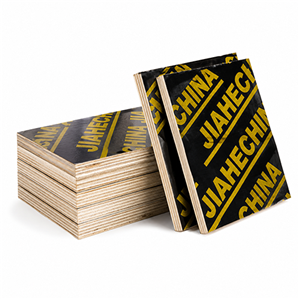
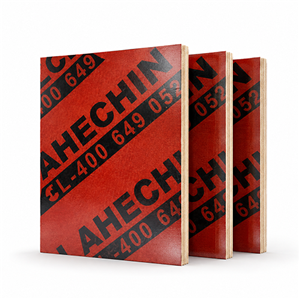
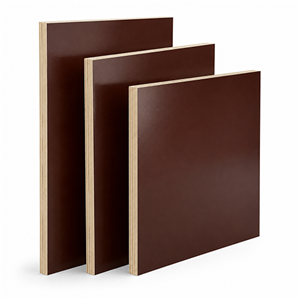
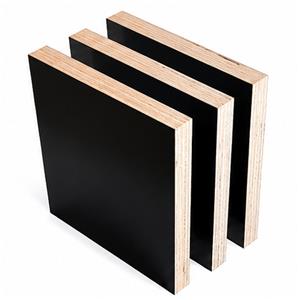
The film overlay forms a dense contact layer between the wood panel and the concrete. A consistent surface can reduce the tendency of cement paste to penetrate the face and can make cleaning easier between pours. It can also contribute to a more uniform concrete appearance when the formwork system is correctly installed. Film quality should be considered together with the release agent, stripping time, concrete mix, and panel condition. A glossy face alone is not proof of a high-performance panel. For more detail on surface options, compare black film faced plywood vs brown film faced plywood.
Strength Comes from the Core
A formwork panel works structurally between joists, studs, walers, or other supports. If the core contains excessive voids, overlapping veneers, weak joints, or inconsistent thickness, the panel may bend unevenly or show local weaknesses. Denser species can provide higher stiffness, but good manufacturing control is just as important as species. A well-constructed poplar or combi core may outperform a poorly assembled denser core. The correct choice depends on loading, support spacing, target reuse, and transport weight.
Thickness Selection Matters
Contractors often specify 12 mm, 15 mm, 18 mm, or 21 mm film faced plywood for concrete formwork. The correct thickness depends on the design of the formwork system. Thicker is not automatically better if support spacing and engineering are unchanged, and a lower-cost thinner panel can become expensive if it causes deflection or requires additional supports. When quotations differ, confirm whether the stated thickness is nominal or actual and whether the supplier controls tolerance across the panel. See 18mm film faced plywood specifications and uses for a common construction grade.
Reuse Depends on the Whole System
Many buyers ask for a guaranteed number of reuses, but site conditions make a fixed promise unreliable. Panels last longer when cut edges are resealed, screw holes are protected, appropriate release agents are used, concrete is removed without damaging the film, and panels are dried and stored flat. Reuse also depends on whether the same panel is used on walls, columns, slabs, beams, or irregular shapes. A project that carefully manages formwork can get far more value from the same grade than a project that strips panels aggressively. Review how to extend film faced plywood service life for practical site measures.
What to Specify in a Purchase Order
A good purchase specification should define panel dimensions, thickness and tolerance, core species or core construction, face film, edge color and sealing, adhesive system, acceptable surface defects, squareness, packing, and marking. If you need a particular concrete finish, include a sample approval requirement. If you will cut panels on site, ask the supplier which edge sealer is compatible with the panel. For container orders, confirm pallet dimensions, sheet count per pack, moisture protection, and loading plan before production.
Conclusion
Film faced plywood for concrete formwork performs best when the panel specification and formwork design are treated as one system. The cheapest sheet is not always the lowest-cost solution, and the most expensive sheet is not always necessary. Define the required finish, support spacing, expected handling, and reuse target, then choose the panel construction that meets those conditions. A clear technical specification gives buyers a much stronger basis for comparing suppliers than surface appearance alone.